Historical frequency
Review how often numbers appeared in a sample history window, then separate real frequency observation from prediction certainty.
Use MiroFish as a careful lottery pattern simulator: review example historical frequency, compare hot and cold numbers, generate random combinations, and read plain-language probability notes before today's draw.
No guaranteed winning numbers. Lottery draws are random events. This page is for entertainment, educational analysis, and simulation only; it is not betting, financial, or legal advice.
MiroFish carries this page as a Lottery Pattern Simulator. The useful output is not a promise; it is a structured way to inspect patterns, randomness, and uncertainty.
Review how often numbers appeared in a sample history window, then separate real frequency observation from prediction certainty.
Group recent high-frequency and low-frequency numbers so the pattern is easy to read without pretending that streaks control the next draw.
Generate clean random sets for rehearsal, comparison, or entertainment. Random generation is still random; it is not a winning method.
A visitor looking for lottery prediction for today usually needs a readable summary, not a magic number. This sample shows the kind of careful explanation a MiroFish-style report can produce.
In a sample 6 from 49 format, the simulator can place recent draws into ranges: low numbers from 1-16, middle numbers from 17-33, and high numbers from 34-49. If the recent sample shows more middle-range activity, the report can note that pattern and still explain that the next draw remains independent. A balanced random set may include numbers from multiple ranges, but balance is a style choice, not an advantage.
Before using any lottery prediction for today page, keep the practical checks separate from the simulation. Confirm the game format, official draw time, local age rules, ticket cut-off time, and whether the draw has already happened. If a page claims guaranteed winning numbers, insider access, or a fixed formula for a random draw, treat that as a warning sign. A responsible simulator should make uncertainty more visible, not hide it.
The visual materials below come from the MiroFish product experience: a first-screen swarm-style prediction environment, a workspace screenshot, and the product walkthrough.
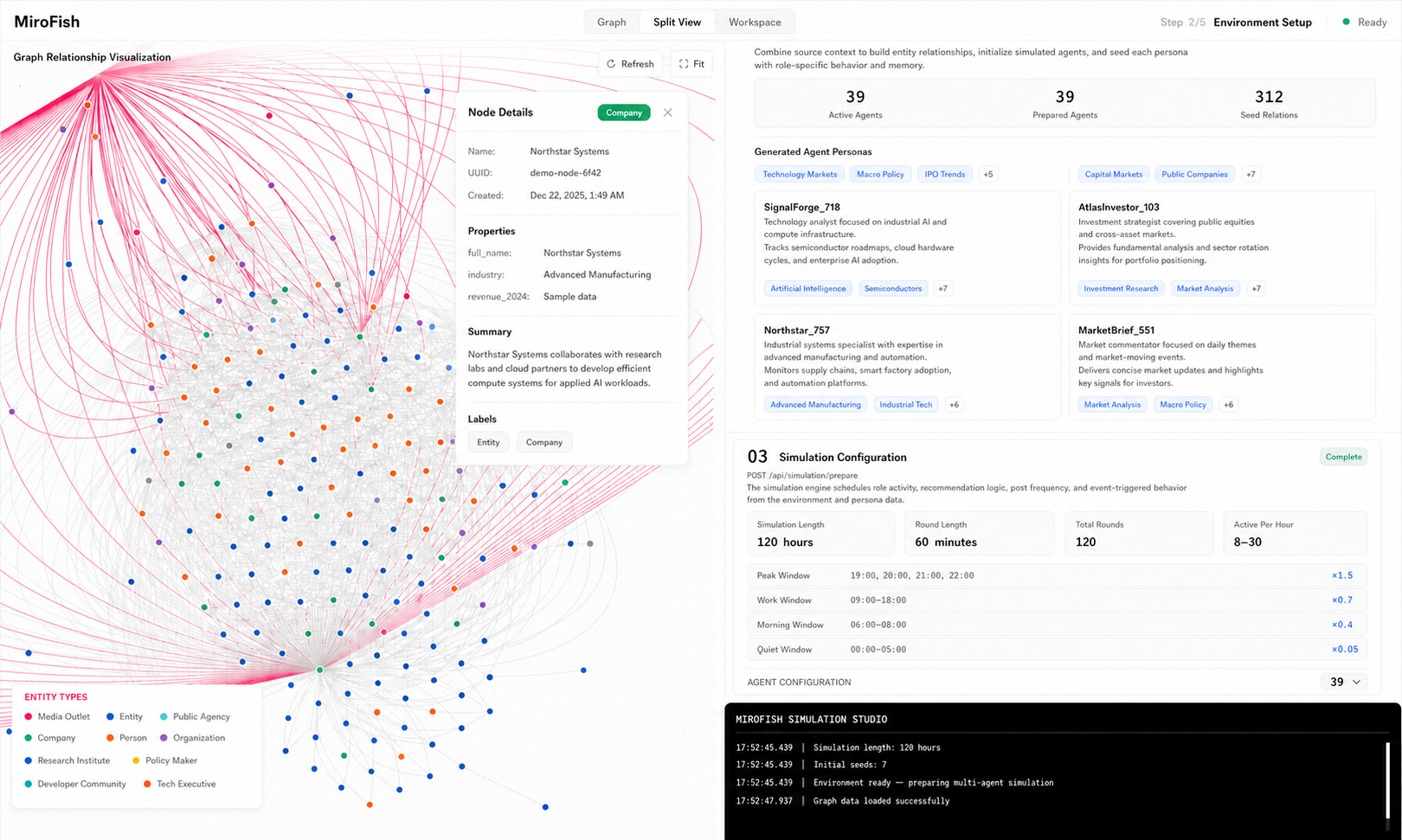
The method separates observation, random generation, and probability explanation so the page stays useful without making impossible claims.
| Step | What MiroFish can organize | What it means | Important boundary |
|---|---|---|---|
| Draw history | Recent draws, number counts, pair appearances, gaps, and repeated ranges. | Helps visitors understand what happened in the sample window. | Past appearances do not force future draws. |
| Hot / cold view | Numbers grouped by recent frequency, absence, and range balance. | Useful for exploring different styles of random set selection. | Hot numbers are not due to continue; cold numbers are not due to catch up. |
| Random combination | Clean random sets with optional balance constraints such as odd/even mix or low/high spread. | Creates sample combinations for entertainment and comparison. | A generated set has the same mathematical uncertainty as any valid set. |
| Probability explanation | Format odds, jackpot-risk context, and plain-language caveats. | Makes the scale of randomness clear before a visitor acts. | Do not treat any simulator output as financial advice. |
The most useful part of a pattern simulator is the explanation around the numbers. The explanation should make the result feel less mysterious, not more certain.
When a number appears often in a sample window, the page can call it a hot number for that window. That phrase describes the sample. It does not mean the number is favored by the next official draw.
A number that has not appeared for a long time can feel due, but a fair draw does not owe that number a return. The report should separate human intuition from mathematical probability.
A generated combination can be neat, balanced, unusual, or memorable. None of those qualities turn it into a guaranteed ticket. Treat the set as a sample for entertainment.
Lottery prediction for today should be read as pattern simulation, not certainty. A fair lottery draw is designed so each valid combination has the same chance under that game's rules. This page can help you think clearly about frequency and probability, but it cannot know the winning numbers in advance.
Short answers for the most important lottery prediction for today questions.
No. MiroFish can organize a simulation and explain probability, but lottery draws are random. The page does not guarantee a result or claim to know future numbers.
Hot and cold numbers are a simple way to summarize sample history. They can make a draw history easier to inspect, but they do not change the odds of the next independent draw.
No. Generated combinations are sample random sets for entertainment and analysis. Official tickets, rules, and results must come from official lottery operators in your location.
Use it to understand how lottery pattern language works, compare random combinations, and keep probability in view. The most important takeaway is that uncertainty remains.